Know exactly what to text, say, and do — when someone you love is hurting.
A quiet, practical toolkit for the first message, the funeral, and the months after — when everyone else has moved on.

Get the free sample chapter.
The first chapter of the toolkit — the exact words and texts to send during this hard season. Sent to your inbox right now.
What's happening right now?
Three quick questions. We'll point you to the chapters written for the moment you're in.
Who are you supporting?
You want to be there. Something keeps getting in the way.
The lump in your throat when their name comes up. The half-written texts you never send. That's not a flaw — that's love with nowhere to go yet.
"I don't know what to say."
Every sentence feels too small, too clumsy, or too close to a cliché. So you say nothing — and then the silence starts to feel like its own message.
"I'm afraid of saying the wrong thing."
You've heard the lines that hurt: 'everything happens for a reason,' 'at least…,' 'they're in a better place.' You don't want to be the person who makes it worse.
"I want to help, but I don't know how."
'Let me know if you need anything' feels hollow. You want to do something concrete — but you're not sure what's helpful and what's intrusive.
"Nothing I do feels like enough."
You can't fix it. You can't bring them back, undo the diagnosis, or rewrite the past. So it's tempting to step back. But stepping back is exactly the thing that hurts most.
None of this means you don't care. It means no one ever taught you how.
Stop guessing. Start showing up with confidence.
Know exactly what to say
A reference sheet and copy-and-paste text templates for every hard moment — so you stop second-guessing and start reaching out.
Know exactly what to do
A practical checklist of concrete actions that actually help — from the first hour to the first year.
Feel more confident supporting someone you love
The S.A.F.E. Method and real-life chapters give you a steady framework — so you show up with calm instead of hesitation.
Six resources. One download. Everything you need to show up with confidence.
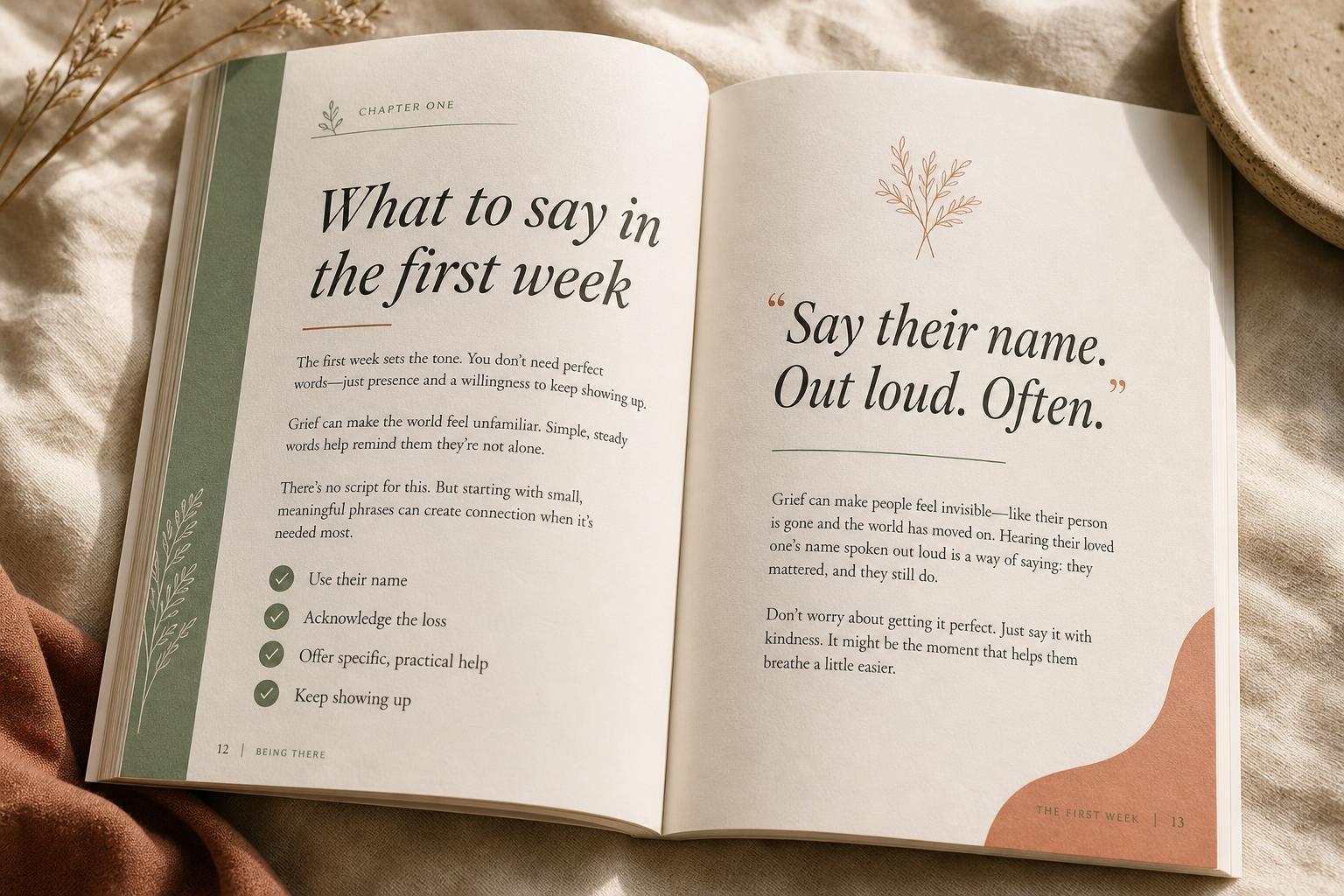
The People Who Stay Core Guide
The full S.A.F.E. Method and real-life chapters for grief, illness, divorce, miscarriage, caregiving, and job loss.
→You stop guessing and start showing up with a framework that works in any hard season.
Support Text Templates
Copy-and-paste messages for the first hours, week one, month three, and every milestone after.
→You never sit staring at an empty text box again.
What To Say / What Not To Say Quick Reference
The 'Never Say' list of kind-sounding lines that quietly hurt, paired with the warmer words to reach for instead.
→You stop accidentally making it worse and start saying the thing that actually lands.
Practical Ways To Help Checklist
Concrete actions that beat 'let me know if you need anything' — meals, errands, school runs, the after-the-funeral check-in.
→You become the friend who did something, not the one who only offered.
Conversation Starters
Gentle openers for the conversations most people avoid — six months in, the first birthday, the quiet Tuesday when no one else is calling.
→You keep the door open long after everyone else has gone quiet.
Hard Dates Support Bonus (incl. Father's Day)
How to show up on the days that hit hardest — Father's Day, Mother's Day, birthdays, anniversaries, and the holidays.
→You're the person who remembered, on the day they needed it most.
Six resources · sold separately, easily $80+ · yours, one time, for $17
Instant PDF toolkit · One-time payment · 30-day refundYou don't need to fix it. You just need to stay.
What you can realistically say
"I'm here." "I'm not going anywhere." The toolkit gives you the exact words for when your mind goes blank.
What you can realistically do
Drop a meal on the porch. Send a text on the three-month mark. The toolkit maps the concrete actions — first hour to first year.
What you're allowed to feel
Awkward. Scared of saying the wrong thing. That's normal — the toolkit meets you exactly where you are.
What makes the difference
Not one grand gesture — the text at week three when everyone else has stopped asking. Small, steady presence beats a perfect speech.

They don't need perfect words. They need someone willing to stay.
Three steps. Read it tonight.

Buy the toolkit
One-time $17. No account. No subscription.
Download instantly
PDF lands in your inbox the moment payment clears.
Open it when it matters
Phone, tablet, or printed — ready the next time someone you love is hurting.
Written from the inside of grief — for the people standing just outside it.
I wrote this because I've lived it. I lost my dad, my mom, and my brother — and in each loss, I watched people I love freeze.
They wanted to show up. They just didn't know how, and the wrong words at the wrong moment landed harder than silence.
Some people knew exactly what to do. They sent the text on a Tuesday in month four. They sat without trying to fix it. They said the dead person's name out loud. They are the reason I'm still standing.
This is the toolkit I wish someone had handed my friends and family — plain, practical, and honest about what actually helps.
If it spares one person the loneliness of being supported badly, it's done its job.
— Pam
who lost her dad, her mom, and her brother

Sit with them. Pour the tea. Don't fill the silence with advice.
Before you buy.
Who is this for?
+
Anyone who loves someone going through something hard and wants to help without making it worse — partners, parents, siblings, best friends, coworkers, neighbors. You don't need a counseling background. You just need to care, and to want the right words ready when the moment comes.
Is this only for grief after a death?
+
No. It's built for grief in all its forms — a divorce, a diagnosis, a miscarriage, a job loss, a long stretch of caregiving, a sudden trauma, or the quiet kind of loss nobody else is naming. The principles, scripts, and checklists work across every situation where someone you love is hurting.
What should I actually say?
+
You'll get a copy-and-paste text library for the first hours, one week, one month, three months, the first birthday, the first holiday, the anniversary, and every awkward moment in between — plus the S.A.F.E. Method so you can respond in real time, even when nothing prepared you.
What should I never say?
+
The toolkit includes a clear 'Never Say' list — the kind-sounding lines that quietly hurt the most ('Everything happens for a reason,' 'At least…,' 'You're so strong') — and gives you what to reach for instead.
What format is included? How do I access it?
+
It's a beautifully designed PDF — readable on any phone, tablet, laptop, or printed at home. The moment your payment clears, you land on a thank-you page with an instant download link, and a copy is also emailed to you so you can re-download anytime. No app. No account to create.
Is this a subscription?
+
No. It's a one-time $17 purchase. No accounts, no recurring charges, no upsells. The PDF is yours to keep forever — read it at your own pace, return to it whenever someone you love needs you.
Do you offer refunds?
+
Yes — a 30-day satisfaction guarantee. If the toolkit isn't useful to you, reply to your receipt within 30 days and we'll refund you in full. No forms. No friction. No awkward questions.
One toolkit. Yours to keep.
The People Who Stay Support Toolkit
Complete digital toolkit · PDF
$17
Launch price · first 50 readers
One-time · Lifetime access
- Core Guide — the complete method, real-life chapters, and long-term support framework
- Support Text Templates — copy-and-paste messages for every milestone
- What To Say / What Not To Say Reference Sheet — the right words, and the ones to avoid
- Practical Ways To Help Checklist — concrete actions beyond 'let me know if you need anything'
- Conversation Starters — gentle openers for six months in, the first birthday, the quiet Tuesday
- Hard Dates Support Bonus — Father's Day, Mother's Day, birthdays, anniversaries, and holidays
- Instant PDF toolkit — yours to keep forever
What happens after you pay
30-day satisfaction guarantee
If this toolkit doesn't help you feel more prepared and less alone in supporting someone through grief, email us within 30 days for a full refund. No forms. No awkward questions.
30-day refund · No subscription · No upsells · Secure checkout by Stripe
Questions before you buy? Email hello@thepeoplewhostay.com
Instant Access After Purchase
- PDF download link appears immediately
- Copy emailed to you for safekeeping
- Works on any device — no app needed
Instant download
PDF in your inbox the moment you pay
One-time purchase
$17 · no subscription, no upsells
Yours forever
Re-download anytime — no account needed
Read at your own pace
30-day refund if it isn't useful
Somewhere, someone you love is hoping you'll be the one who stays.
You don't have to be perfect. You don't have to have the right words memorized. You just have to be willing — and to have something to reach for when the moment comes. That's what this toolkit is. A quiet, steady hand on your shoulder so you can be one on theirs.
Be the person they remember — not the one who disappeared.